


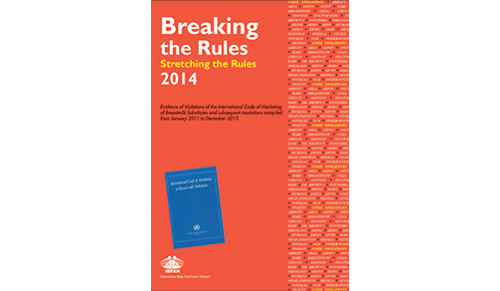
‘Breaking the Rules, Stretching the Rules’ (BTR) 2014, a new publication by IBFAN, presents evidence of breaches of the International Code of Marketing of Breast-milk Substitutes.
The new report ‘Breaking the Rules’ published in January 2014 by IBFAN-ICDC (IBFAN International Code Documentation Centre), details global trends in marketing by baby food manufacturers and denounces violations of the International Code of Marketing of Breast-milk Substitutes and subsequent relevant resolutions of the World Health Assembly between 2011 and 2013.
- Summary of the report, in English (PDF)
- Download Press release Français | English (PDF)
- Video of the presentation of the report at the Swiss Press Club, Geneva, 16 May 2014, in English, see here https://pressclub.ch/blaming-and-shaming-the-milk-companies/
- GIFA page on the International Code
Some 813 breaches committed in 81 countries are listed in this report, which names each of the 27 manufacturers involved. It points out that breastfeeding rates will continue to fall as long as commercial promotion is allowed to compete with breastfeeding and undermine mothers’ confidence in their own ability to feed their children.
The inevitable consequence is a rise in infant mortality and morbidity rates.
This report reveals only the tip of the iceberg, but it offers a good overview of the main trends and commercial strategies of the last three years:
- Competition between manufacturers has intensified. The profitability and enormous size of the infant formula market (41,000 million dollars) have led to numerous corporate takeovers, leaving two giants head-to-head: Nestlé and Danone. This has not prevented smaller manufacturers, such as Friesland (Netherlands), Liptis (Switzerland) and HiPP (Germany), from flouting the Code with impunity.
- Social media is now widely used as a marketing tool. Twitter, Facebook, YouTube, Instagram, Google+ and other ‘apps’ downloaded by millions of people are communication channels used by manufacturers to reach mothers. These new media offer endless opportunities for direct interaction with consumers. For example, bloggers are used to provide advice on products.
- Hospitals remain the most effective point of entry for companies. Mothers trust healthcare professionals and tend to rely on the brand used in the hospital. Company representatives are trained to persuade doctors, by any means necessary, to prescribe or recommend their products. In 2013, in just one Chinese city, Dumex (owned by Danone) was accused of bribing 116 doctors and midwives across 85 medical establishments.
- China in the spotlight. Dozens of companies, both large and small, are competing for a share of the highly profitable Chinese infant formula market. Around 20 million babies are born in China every year, and the infant formula market is expected to reach annual sales of 25,000 million dollars by 2017. Following an investigation carried out in 2013, six companies were fined $108 million for collusion on selling prices. Five of them are featured in this report: Mead-Johnson, Abbott, Danone, Friesland and Fonterra.
- Enriched infant milks, also known as ‘growing-up milks’, are mainly used as a means of ‘cross-promotion’ for infant formula and follow-on formula, which often carry a similar brand name. ‘Growing-up milks’ offer no nutritional advantage over traditional foods, but their aggressive marketing has made them the most successful market segment. Sales of these milks grew by almost 17 per cent in 2012, whilst follow-on milks grew by 12 per cent. Asia is the largest market for these products which, although not necessary, already account for a third of the value of the global infant milk market.
- Sponsorship is on the rise. Companies regularly target doctors, nurses, midwives and nutritionists, offering them airfares to attend conferences held in luxury venues, gifts (such as expensive laptops), prize draws, etc. The report contains visual evidence of this in unexpected places such as the United Arab Emirates, Turkey and Iraq.
- Sponsorship of professional associations is also on the rise. Companies continue to sponsor professional associations in both developing and industrialised countries. For example, in the run-up to the 20th Congress of the International Union of Nutritional Sciences, held in Spain in 2013, Abbott, Nestlé, Danone, Wyeth, Hero, Mead Johnson and Friesland made ‘contributions’ ranging from 40,000 to 75,000 euros.
- ‘Closer than ever to breast milk’. Advertising for infant formula always includes positive messages about breastfeeding, immediately followed by phrases suggesting that the product in question is ‘almost’ as good. The current trend is to claim that the milk in question is ‘inspired by breast milk’ or ‘faithfully reflects breast milk’. Wyeth, now owned by Nestlé, has launched a new product range called Illuma, a ‘human-affinity formula’. Nestlé states that it will ensure Wyeth applies the FTSE4Good criteria, but these criteria do not meet the minimum standards set by the Code and Resolutions.
- Claims. One of the manufacturers’ favourite strategies is to promote their product with health and nutritional claims, such as that it has ‘the most advanced nutrient system’ or that the product’s ingredients protect babies from infections and improve eyesight and intelligence. In reality, very few of these claims are supported by independent research, and all suggest that breast milk and family foods are in some way deficient.
Marketing is to blame. Although rates of exclusive breastfeeding rose everywhere in the early 1990s (UNICEF 2012), the global rate has since remained below 40 per cent. For example, the proportion of babies exclusively breastfed in East Asia fell from 45 per cent in 2006 to 29 per cent in 2012. In Indonesia, the figures show a 10 per cent decline in the exclusive breastfeeding rate. In the Philippines, only 17 per cent of babies are currently exclusively breastfed. This is largely due to the marketing of breast-milk substitutes. In most countries, companies pay healthcare workers to promote the use of their formulae. According to a report by Save the Children (2013), in China 25 per cent of mothers have received gifts and 40 per cent have received product samples from manufacturers, all in breach of the Code.
The blame lies with the major manufacturers. IBFAN works to put an end to breaches of the Code, regardless of which company commits them. Due to their size, Nestlé and Danone have the greatest impact, and Nestlé is often the one opposing binding regulations. There has been an international boycott against Nestlé for years. Messages sent to Nestlé by thousands of boycott supporters have brought about some changes, such as Nestlé’s promise to stop claiming that its milk is ‘the new gold standard in infant nutrition’. Nestlé maintains that 90 per cent of the breaches of which it is accused ‘do not contravene [its] policy’, which demonstrates the extent to which Nestlé’s policy in this area does not comply with the Code or the resolutions.
Danone has risen to second place in the global infant formula market after buying up smaller infant food manufacturers one by one. The company is now guilty of numerous breaches. Representatives from Dumex and Nutricia target healthcare professionals in particular. Danone also attempts to link its name to charitable organisations and government initiatives through partnerships. For this reason, IBFAN is launching a campaign: ‘DanoNO: Say NO to corporate philanthropy’, and continues to call on Danone to cease all breaches.
Manufacturers have always sought to marginalise IBFAN, claiming it is the only organisation that criticises their business practices. However, other organisations, such as Save the Children and UNICEF, also insist that the situation must change. Even the Nutrition Access Index, which is influenced by the manufacturers, states that ‘the company (Nestlé) should take immediate action to ensure that its practices fully comply with the International Code in all countries’.
STOP PRESS: Evidence that an independent report, such as *Breaking the Rules*, is necessary has recently come to light: in India, Danone allegedly manipulated an audit report on its operations to conceal evidence of the company’s illegal sponsorship of doctors (1).
Contacts: ICDC-IBFAN, Penang
GIFA-IBFAN, Geneva, Tel. +41227989164, info@gifa.org;
UK BMA Baby Milk Action Network: Patti Rundall, prundall@babymilkaction.org, Tel. +441223464420